
2014-10-14Visual Testimony in Venice
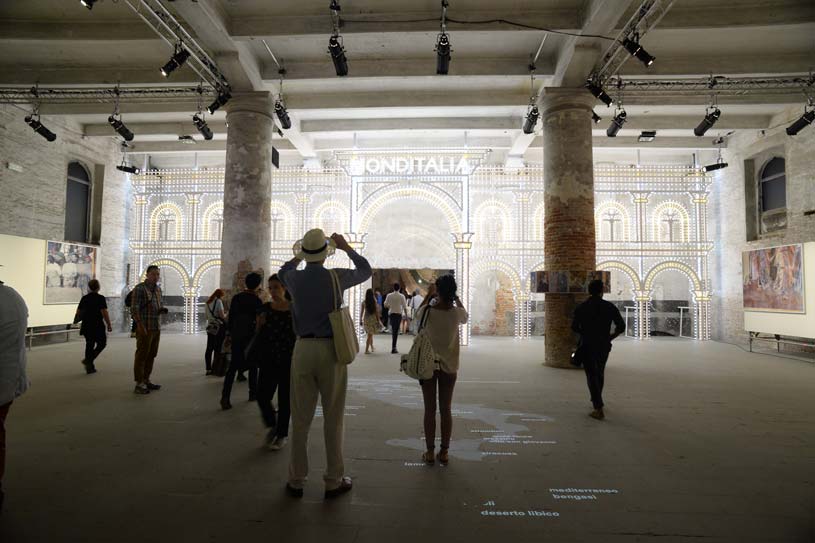
As director of the 14th Venice Architecture Biennale, Rem Koolhaas has made many architects feel very uncomfortable. His theme of Fundamentals is about ‘architecture, not architects’. It spotlights the discipline itself, not the creators, and focuses on the past, not on the future. In the two main exhibitions, Elements of Architecture and Monditalia, past and present are presented as necessity. Music, dance, stage and film are considered essential to understanding this.
In the exhibition Elements of Architecture, Koolhaas examines the fundamentals of building that have always been used by architects everywhere. The message for architects here is that broadening of the profession is no longer desirable. What is needed is deepening. Architects must know more about what their profession is about. A prominent place on the bookshelves should once again be reserved for Neufert Architect’s Data, while all those glossy photo books of buildings by architects should be consigned to the waste paper recycling.
No space whatsoever is reserved in this exhibition for creations by architects that combine all elements. Instead, a film is deployed to demonstrate the importance, functional but certainly social and cultural too, of the elements. Italian architect Davide Rapp and his team spent two years combining through feature films to compile hundreds of original fragments into a wonderful introduction to Elements of Architecture. The film shows the (incorrect) use of the balcony, the corridor, the stairs, the ceiling, the lift, the escalator, the facade, the floor, the fireplace, the ramp, the roof, the toilet, the wall and the window. The fragments come from old and new films and cover practically every genre. Isolated as fragments, the elements acquire new meaning, and the resulting composition reveals the close yet ambivalent relation between film and architecture, when the latter is deployed only as decor.
Monditalia
The exhibition Monditalia also lacks beckoning panoramas or iconic buildings by architects for architects. Instead, Monditalia focuses on Italy. The exhibition scans the country from south to north on the basis of 41 themes. Each subject has a unique location and specific conditions, but together they form an extensive and original portrait of the host country in the field of planning, urbanism, architecture and landscape design. Performing arts and cinematography constitute an integral part of this exhibition.
The (fragments of) 82 films on show in the exhibition were chosen by Alberto Barbera, director of the Venice International Film Festival. Each theme in the exhibition is interpreted again on the basis of two feature films. At the same time, the selection of films provides an impressive overview of the country as seen through the eyes of mostly Italian directors. The Intermundia study by Ana Dana Beros on African immigrants and Lampedusa is set between the films Lamerica (1994, Gianni Amelio) and Lettere dal Sahara (2006, Vittorio de Seta). The bare buttocks of Brigitte Bardot in Le Mepris (1963, Jean-Luc Godard) and the oppressive eroticism in Nostra Signora dei Turchi (1968, Carmelo Bene) evoke the right mood for the subject of The Architecture of Hedonism, about villas on the island of Capri, by Martino Stierli. The cheerful actor Fernandel and an unemotional Robert de Niro offer their individual interpretations of Countryside Worship by Mathilde Cassani in the films Don Camillo (1952, Julien Duvivier) and Novecento (1976, Bernardo Bertolucci) respectively, both of which are set in and around the village of Fiorenzuola.
The only criticism of the film selection is that the choice is biased towards works from the distant past. Such an inclination towards romanticism is understandable, given the wonderful films made in Italy during the 1950s, 60s and 70s. The most recent film is Non Pensarci (2007, Gianni Zanasi). Italian cinema has been undergoing a renaissance in recent years, but directors like Paolo Sorrentino (La grande bellezza, Il Divo), Matteo Garrone (Gomorra) and Luca Guadagnino (Io sono l'amore) are omitted. In their films they show the painful reality of present-day Italy, but they did not apparently fit into one of the subjects.
The classification of films according to subject is an intense visual testimony to urban and landscape structures, social and industrial decors, economic and political perspectives, individual and collective ambitions. Together, the selected fragments form a mosaic of interpretations of Italy and its history. Monditalia is an exceptionally critical and often confrontational self-examination, altering our impression of Italy from the beautiful country we know from advertisements to a contemporary, idiosyncratic and more layered society.
In his description, Koolhaas notes that Monditalia symbolises a phenomenon that appears all over the world: many countries balance like Italy between chaos and a realisation if its interesting possibilities. More countries in Europe, the Netherlands among them, would benefit from a scan and reinterpretation of the relation between spatial design and society. But making an exhibition like Monditalia is almost impossible, for the history of Italian cinematography is bigger, more wide-ranging and more beautiful. Italian film directors are unmatched in establishing an interesting relationship between a society and the spaces around it.
This article was published on the website of the AFFR.
The 14th Venice Architecture Biennale is on show until 23 November 2014. Each Friday one of the 82 films is screened.
