2013-11-07Souper #48

img

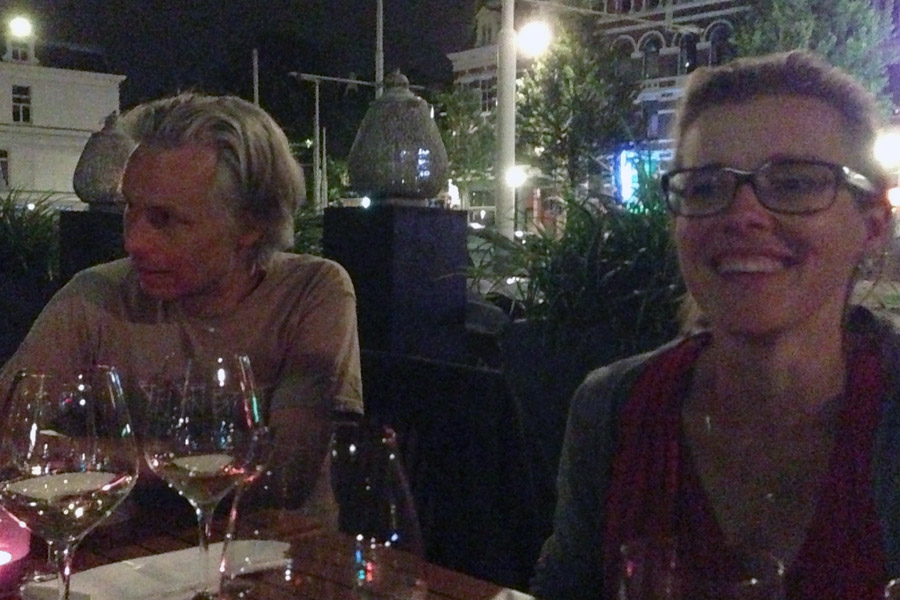
Esther van Heemskerk (Department of Urban Development Rotterdam) en Duzan Doepel (architectenbureau DoepelStrijkers) were our guests on Monday, October 28th. Esther worked on -Klein en Fijn- and the Architecture Perspective of Rotterdam. Duzan is professor Sustainable Architecture and Urbanism at the Research Institute for Sustainable Solutions at the Hogeschool Rotterdam and made the book -Rotterdammers maken de stad-. Rotterdam Architecture City was the obvious theme of the evening. Rotterdam marketing helps us in there for years. But they like to look back and take the current city as a starting point. In contrast to Rotterdam designers and researchers. They look ahead. What does the Rotterdam of tomorrow look like? We did not agree this evening, but our guests shared with us a range of ideas.

The food at Huson is often very good. This evening the food was sublime.

Daan Bakker (Daf-architecten), Jeroen de Willigen (DeZwarteHond), Jasper de Haan (architect) and I invite each month a number of colleagues to eat, drink and discuss about our profession, the city of Rotterdam and related matters.
2013-10-11Architecture Film Festival Rotterdam 2013

img

A hundred films that deal with architecture or interfaces with it will be screened in In the Rotterdam cinema LantarenVenster from 10 to 13 October.

A few tips:
Haus Tugendhat
How do you deal with masterpieces that have fallen into disuse? Do you leave the traces of time visible when renovating or restoring such works or do you endeavour to restore everything as it was once intended? The film tells the story of the difficult struggle in the twenty-first century of the Tugendhat heirs to give this cadavre exquis, designed by Mies van der Rohe, a new lease of life. It resulted in the building as Mies once intended it, but is everyone pleased with this?


Unfinished italy
Italy is the Walhalla of ruins, historical and modern. According to the filmmaker, “the unfinished” has been the most prominent architectural style in Italy since World War II. A theatre that has never had a public, a stadium where no game has ever been played, all languishing in their unfinished state. A report of a fascination with, as well as a quest for, a use for these “UFOs in the landscape”.


This Space Available
Billboards and commercial messages dominate the public space as never before. Renovation projects are seldom without gigantic advertising boards and vacant display windows are successfully leased as “shopvertising”. It is visual pollution, but can this be reversed? This documentary looks at diverse activists from the world of advertising, street art and politics. It focuses on the tense retationship between the two-dimensional, visual attention, the urban economy and social coherence in the city.


16 Acres
Poignant documentary about the emotionally-charged construction site of the WTC towers in New York. The reconstruction of Ground Zero is the most complex regeneration project in the history of America: architecturally, politically and emotionally. Since inception the project was burdened by controversies, delays and political intrigue. The conflict lasted more than ten years, with nineteen state agencies involved, a dozen or so projects and more than twenty billion dollars in costs. The good thing is that this entire process was filmed. 16 Acres is the story of the last ten years on this emotionally-charged construction site, told by the major players in this drama. A must-see for every planner.


Kleiburg
The fascinating account by filmmaker Jeroen Visser about the once-applauded, but rapidly-abused Bijlmermeer in Amsterdam. On completion in the late sixties the estate was called the apotheosis of Dutch public housing. A neighbourhood that would bring happiness to tens of thousands of poorly-housed Amsterdammers. But the neighbourhood was quickly criticised owing to its huge scale, inhospitable atmosphere and lack of security. The Kleiburg block is the pars pro toto where glory, decline and cautious resurrection are visible.


The Human Scale
In 1971 Jan Gehl wrote his bible Life Between Buildings and now, forty years later, there is the film. The documentary shows how his bureau advises people how to make urban areas and public space “liveable”. His plea meets with approval among politicians and inhabitants, who miss a human approach to the street in other architects’ work. His projects in Melbourne, Dhaka, New York, Chongqing and Christchurch are reviewed. An entertaining film about this “cosy” urban design.


Reconversao
In this film Thom Andersen (Los Angeles Plays itself) seeks the essence of Souto de Moura’s architecture, Pritzker prize-winner and designer of the Braga football stadium, among others. Hardly a “talking head” to be seen in this film, instead, many breathtaking images of seventeen buildings and unfinished projects by this impressive architect.


See full program: www.affr.nl

2013-10-06Pearls in the landscape

img

Architects have a problematic relationship with the landscape. In urban areas architects justify a building with the requisite programme and relate it to the developed context. Building in the landscape frequently raises the question of why a programme should be added at all: competing with a splendid or robust landscape is generally already a lost cause for the building. Three films show what it is about: romance.

Architects Gunnar Daan and Cor Kalfsbeek have made a prominent contribution to the architecture in the empty landscape of the northern Netherlands. In the documentary In Context they comment on each other’s work. The projects they review are meticulously embedded in the landscape. Daan, however, vividly explains what the relationships are: “if a new house has the semblance of enjoying the landscape, then the landscape will also enjoy the house”.

In the short film Sizígia the architect, Álvaro Siza, does not actually speak. This is not a shortcoming. Fortunately, the Leça da Palmeira swimming pool complex on the Portuguese coast requires no explanation. Siza tamed the seawater, transforming it into a calm, inviting expanse of water in an irresistible combination of an artificial concrete construction and a capital landscape. In anticipation of swimmers and, presumably, one or two architecture tourists, we follow the not-very communicative caretaker as he prepares the complex for the new season.

Andrea Palladio (1508-1580) was possibly the first architect who intentionally positioned his villas in the landscape. In the film version of Mozart’s Don Gioavanni, we are treated to three hours of Palladio’s work. Villa Rotonda in Vicenza forms one of the decors in this splendid production by Joseph Losey. The problematic relationship between the architect and the landscape also originates, strangely enough, from Palladio himself. His four books on architecture mainly explore the relationships and structure of a building, but he pays little attention to positioning the building in a landscape, whereas studies have revealed that he was extremely exacting in this respect. His preferred site for a building was on top of a hill or a spot by a river.

Without the rationality of the programme and without a developed context, architecture in the landscape can be judged by its relationship to the landscape and its affinity with the user. Listening to architects talking about this romantic concept is somewhat discomforting. Looking at architecture in the landscape, on the contrary, is very comforting.

Article published in the magazine AFFR 2013 and on the website of the AFFR .

Check the website of AFFR for screenings

2013-10-01Souper #47

img

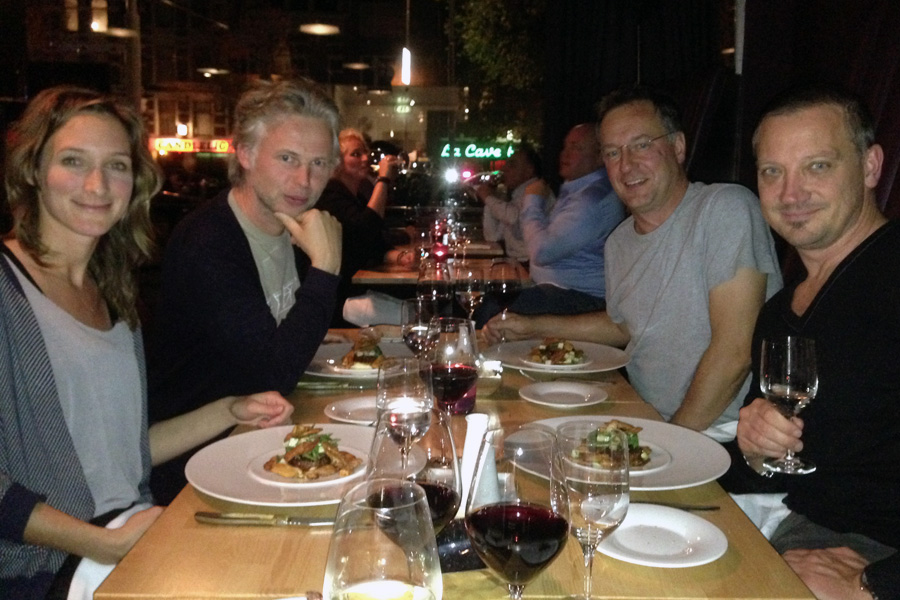
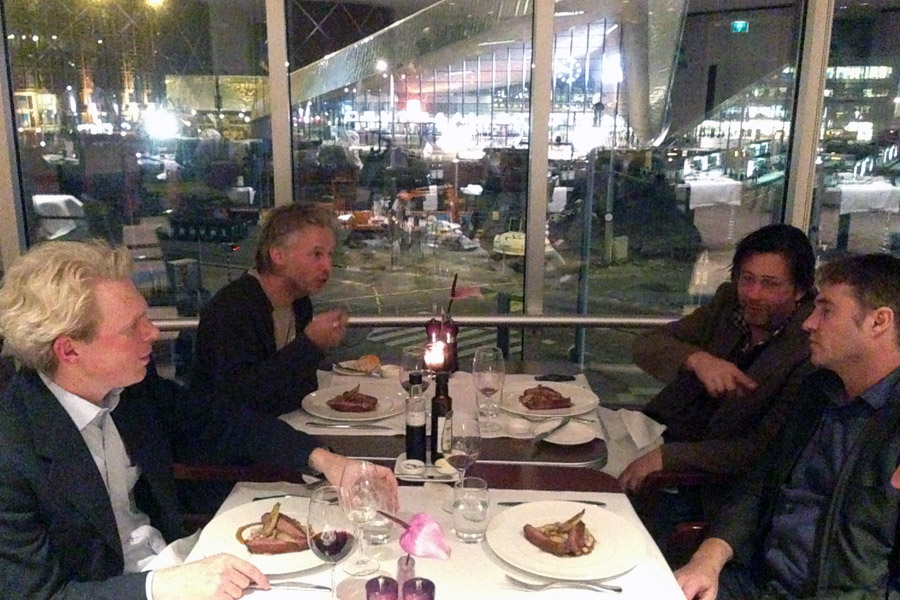
Monday September 30th we had a diner with Ronald Wall (EUR PhD. Economic Geography) and Paul Gerretsen (Agency Deltametropool). The logical subject of this evening economy and city. The academic opportunities Ronald were discussed on the basis of the practical experience of Paul. The political reality of Netherlands was mirrored with research experiences from around the world. It was a very interesting conversation. Each month there is a book or research published by the triumph of the city confirmed. I'm beginning to understand why this is.

A very suitable location for this Souper was The Manhattan Brasserie in Hotel Manhattan opposite the new central train station in Rotterdam. The view was better than the food.

Daan Bakker (Daf-architecten), Jeroen de Willigen (DeZwarteHond), Jasper de Haan (architect) and I invite each month a number of colleagues to eat, drink and discuss about our profession, the city of Rotterdam and related matters.
2013-09-04Souper #46

img

Writer Sanneke van Hassel and photographer Jannes Linders were our guests on Monday August 26. The city plays with its inhabitants and users plays an important role in the work Sanneke and Jannes. As setting for a touching scene. As machine for entertainment. As a pleasant place to live. As a ruthless workplace. With a sharp pen or a intense image they are trying to make. contemporary urban life for us to understand. The warm summer evening on the sidewalk for restaurant Huson was a pleasant backdrop to listen how they think and work.

Daan Bakker (Daf-architecten), Jeroen de Willigen (DeZwarteHond), Jasper de Haan (architect) and I invite each month a number of colleagues to eat, drink and discuss about our profession, the city of Rotterdam and related matters.